
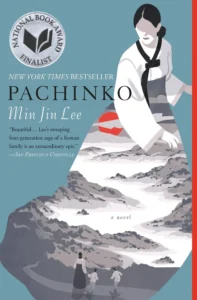
Author: Min Jin Lee
Plot: In early 1900s Korea, young Sunja falls for a wealthy man who leaves her pregnant and betrayed. Refusing his support, she marries a kind minister and moves to Japan, setting off a multigenerational saga of love, sacrifice, and resilience. Pachinko follows a Korean family’s struggle to endure and thrive amid discrimination and hardship across decades.
I first encountered Pachinko during a transformative period of my life. I had recently moved to Budapest amidst the final semester of my university studies. Balancing a new job with the pressures of completing my thesis and preparing for a pivotal state exam left me in a constant state of nervousness. The fear of jeopardizing three years of studying due to a single exam haunted me. Amidst this tumult, my social life was sadly nonexistent.
In that context, stumbling upon a cleverly named book club, Wanderlust, nestled within the vibrant city of Budapest, felt like ray of hope. My initial attempt to participate was thwarted by two factors: the imminent state exam for which I was unprepared, and my inability to finish the club’s December selection. Wisely and prudently, I deferred my involvement until January.
With the new year came a sense of liberation from academic burdens. Seizing the opportunity, I immersed myself in Min Jin Lee’s Pachinko, the club’s book of the month. The experience was nothing short of exhilarating. Over four days, I devoured the 700-page multigenerational saga that narrates a Korean family’s journey through 20th-century Japan during the annexation of Korea. The narrative unfolds across three parts, each mainly focusing on a different generation, painting a vivid tapestry of resilience and identity.
Lee’s prose masterfully bridges cultural divides, rendering foreign landscapes and histories accessible and deeply human. Her characters are intricately drawn, evoking empathy and introspection. While I found myself deeply connected to the earlier generations, the latter part of the novel, focusing on younger characters, felt somewhat rushed, leaving less room for emotional investment. Nevertheless, this minor shortcoming does not diminish the novel’s profound impact.
Pachinko stands as one of the most compelling reads I’ve encountered in recent times. The fact that it took Lee 30 years to craft this masterpiece is a testament to its depth and authenticity. The novel delves into themes of immigration, discrimination, identity, and perseverance—issues that remain pertinent today. Though centered on a single family’s saga, its insights resonate universally.